
How the green factor score is calculated
Understand Brisbane Green Factor. Find out what the green factor score is and how it’s calculated.
What is the green factor concept?
Brisbane Green Factor measures the quantity and quality of green infrastructure on development proposals.
To do this, it captures the total amount of green elements and weighs the value of each against 6 ecosystem service areas.
The combination of these factors is then measured against the site area to calculate the green factor score.
The basic green factor equation

Because the green factor is relative to a project’s size, the score can be used to compare and benchmark urban development projects.
This equation provides an indication of a project’s composition, with projects that have more green elements likely to score higher.
What influences the green factor area?
The quantity of green elements on a site determines a project’s green factor area. This includes elements grouped together or located in the ground or on walls, facades and roofs.
However, the calculation of each individual element is more nuanced.
This calculation:
- rewards certain types of vegetation over others (e.g. native trees over exotic trees)
- penalises the removal of existing presumably mature elements (removed elements that are replaced with new elements will see a smaller penalty that reflects a difference in size between a new element)
- rewards the retention of presumably mature green elements (this benefit comes from the assumption there is a difference between the size of a new versus mature and retained element)
- rewards elements that have more favourable configurations at each location (e.g. elements that are publicly visible and accessible are scored higher than those that are hidden or publicly inaccessible)
- rewards elements that are more desired for their greening efficacy against a set of ecosystem services that have been chosen and prioritised.
The green factor area can be thought of as the sum of its element-level parts. These components are a useful way to step through how the green factor area is determined.
The green factor area equation
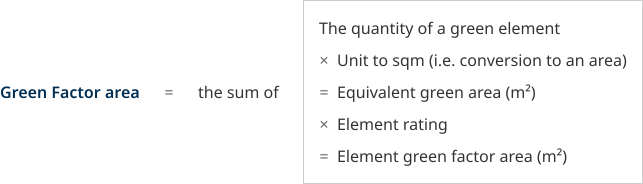
Like most mathematical equations, it can be more useful to step through a practical example.
The Brisbane Green Factor tool features this same equation as an interactive view option for data tables in the green factor scorecard.
Council recommends using this to step through this equation for each element in your own assessment to better understand how it works.
Typology base scores
Different types of buildings and projects face different economic and feasibility pressures and challenges in delivering greening outcomes.
Different base scores have been assigned to recognise this complexity.
| Site typology | Base score |
|---|---|
| Small-scale residential | 0.4 |
| Medium-scale residential | 0.5 |
| Large-scale residential | 0.6 |
| Hotel or other accommodation | 0.5 |
| Retail, shop or service | 0.25 |
| Shopping centre | 0.4 |
| Public building | 0.5 |
| Community facility | 0.4 |
| Commercial office | 0.5 |
| Light industrial or warehouse | 0.25 |
| Service station | 0.3 |
How green elements are rated
Not all greenery is valued equally by Brisbane Green Factor.
For instance, indigenous vegetation is the most valued vegetation, followed by productive, native and exotic.
Within the tool, each green element is given an element rating.
- The rating incorporates how that element performs against a set of 6 ecosystem services for Brisbane. This performance rating is done via expert judgement and research on a zero to 3 score against each ecosystem service. Each elements’ ecosystem rating is initially made for a benchmark element configuration at each location (e.g. publicly accessible, visible and on ground).
- The rating is adjusted to individual ecosystem ratings based on different element configurations at each location group.
Brisbane ecosystem services
| Ecosystem service | Relative weight |
|---|---|
| Food production | 5% |
| Habitat provision | 15% |
| Sense of place | 25% |
| Stormwater management | 20% |
| Urban temperature regulation |
20% |
| Wellbeing and health |
15% |
The result of this process is a table of 1,077 uniquely configured elements that are rated for all ecosystem services within the Brisbane context. All ecosystem ratings are then reviewed.
- Normalised: This is calculated by dividing each rating by the median score of all vegetation elements. This robust normalisation process is applied to ensure ratings and scores are in a reasonable range.
- Adjusted by ecosystem service weights: This is based on how Council prioritises each ecosystem service. This is done by multiplying Council's ecosystem weighting by each normalised rating.
- Summed into a final element rating: This is used to convert the physical or equivalent area of an element.
Because these weights reflect Council's strategic priorities, elements that rate better against these preferred ecosystem services are rewarded in their green factor scores.
Components of an element rating
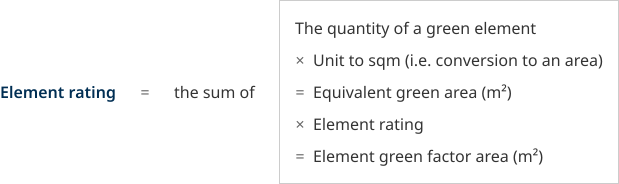
These treatments result in a unitless, index-style element rating that is centred around 1.0, and ranges from about 0.1 to 2.5.
Like most mathematical equations, it can be more useful to step through a practical example.
The Brisbane Green Factor tool features this same equation as an interactive view option for data tables in the green factor scorecard.
Council recommends using this to step through this equation for each element in your own assessment to better understand how it works.